Modern IT Management

Devices. People. Accounts. Docs. The network. Converging, not drifting, in one easy UI.
For small IT teams and MSPs with hundreds (even thousands... shhh) of users and big aspirations.

Self-hosted, open source. git clone and go.
Clear, simple, powerful. Takes 2 seconds to learn.
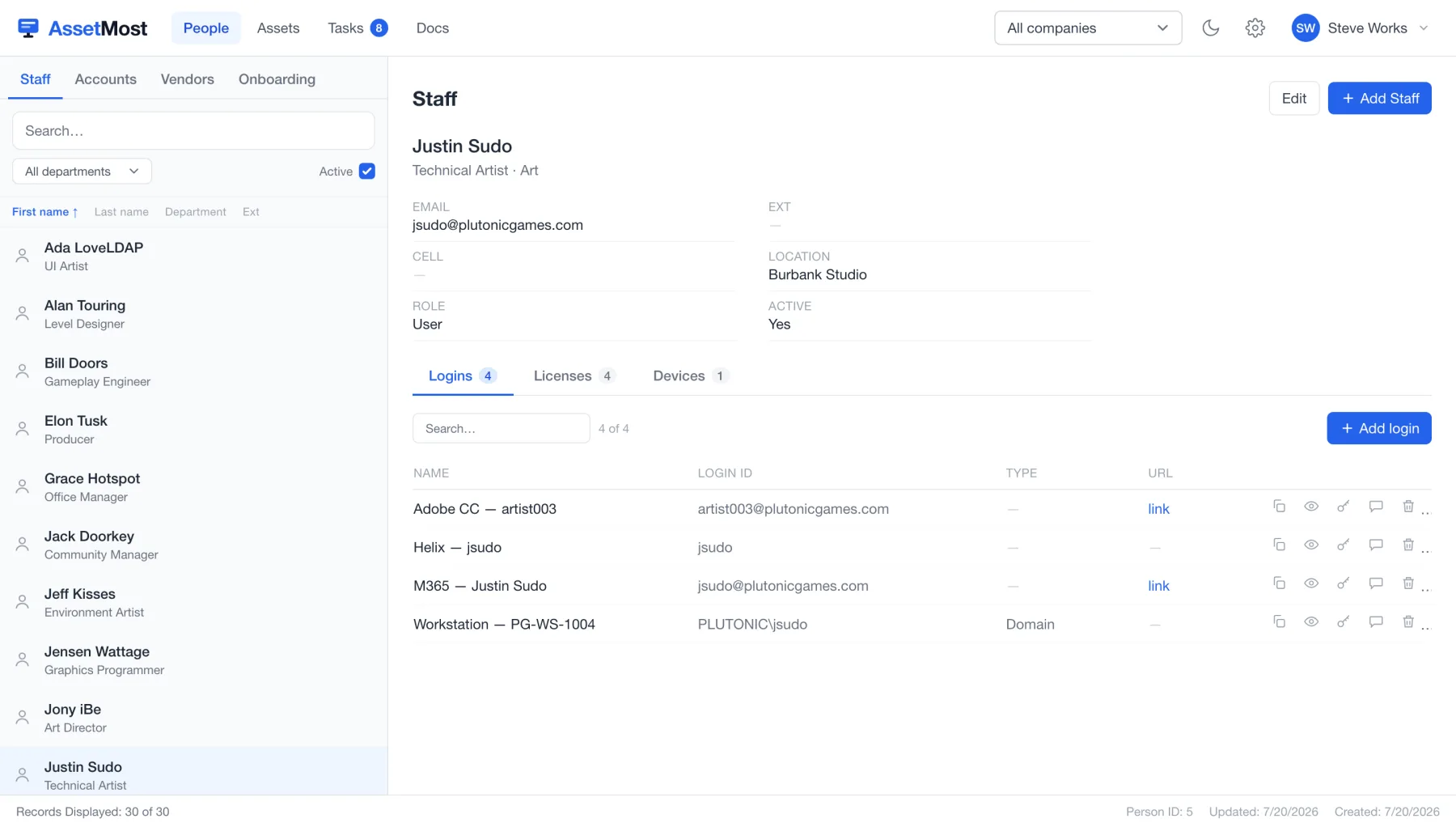
A staff profile: contact details with logins, licenses, and devices in one place
1 · People

One person, one screen.

Logins, licenses, and devices on the person who holds them.
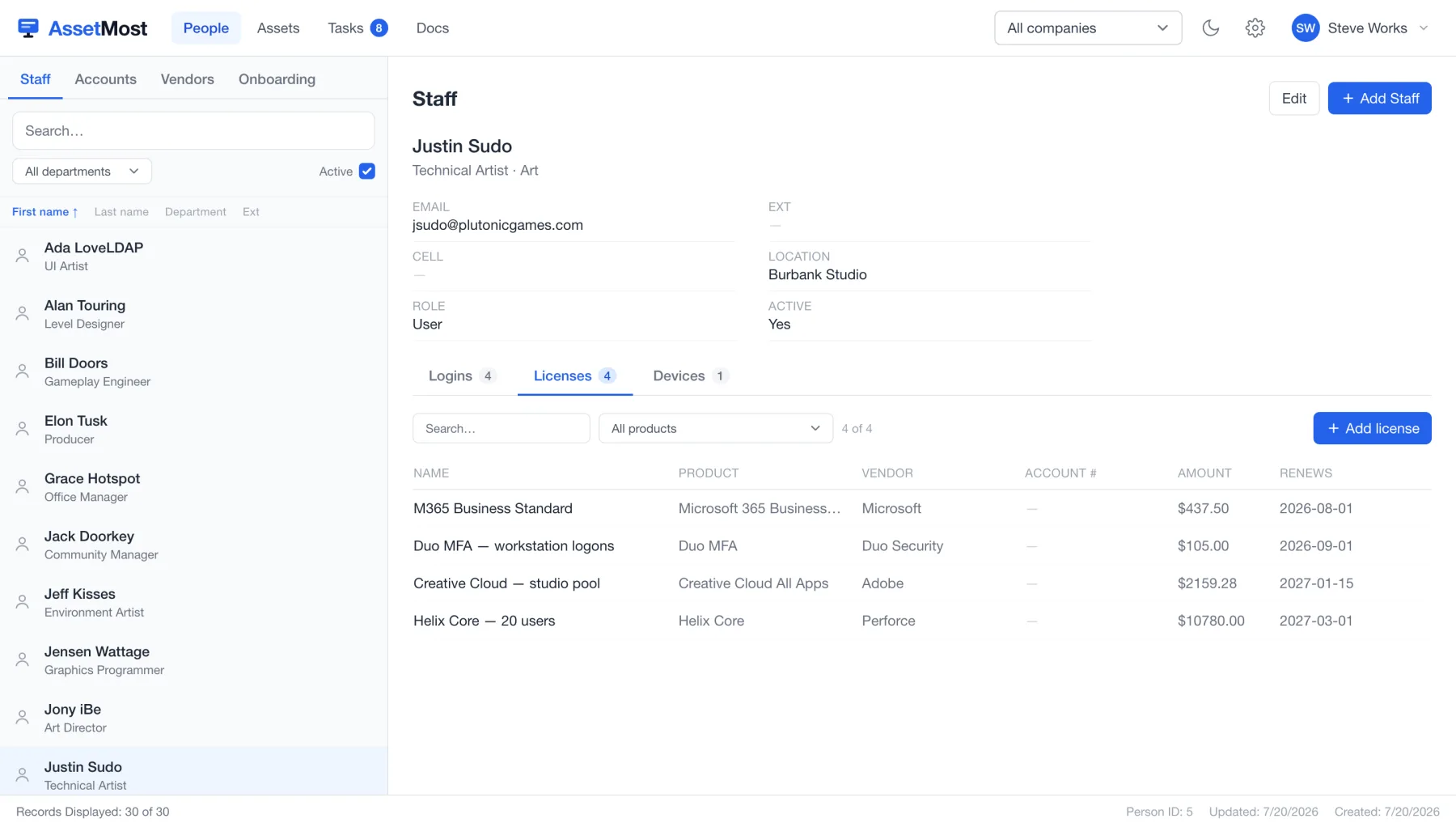
License seats on a person: product, vendor, amount, renewal date
2 · Licensing

Every seat, priced and dated.

Product, vendor, cost, and renewal in the same row.
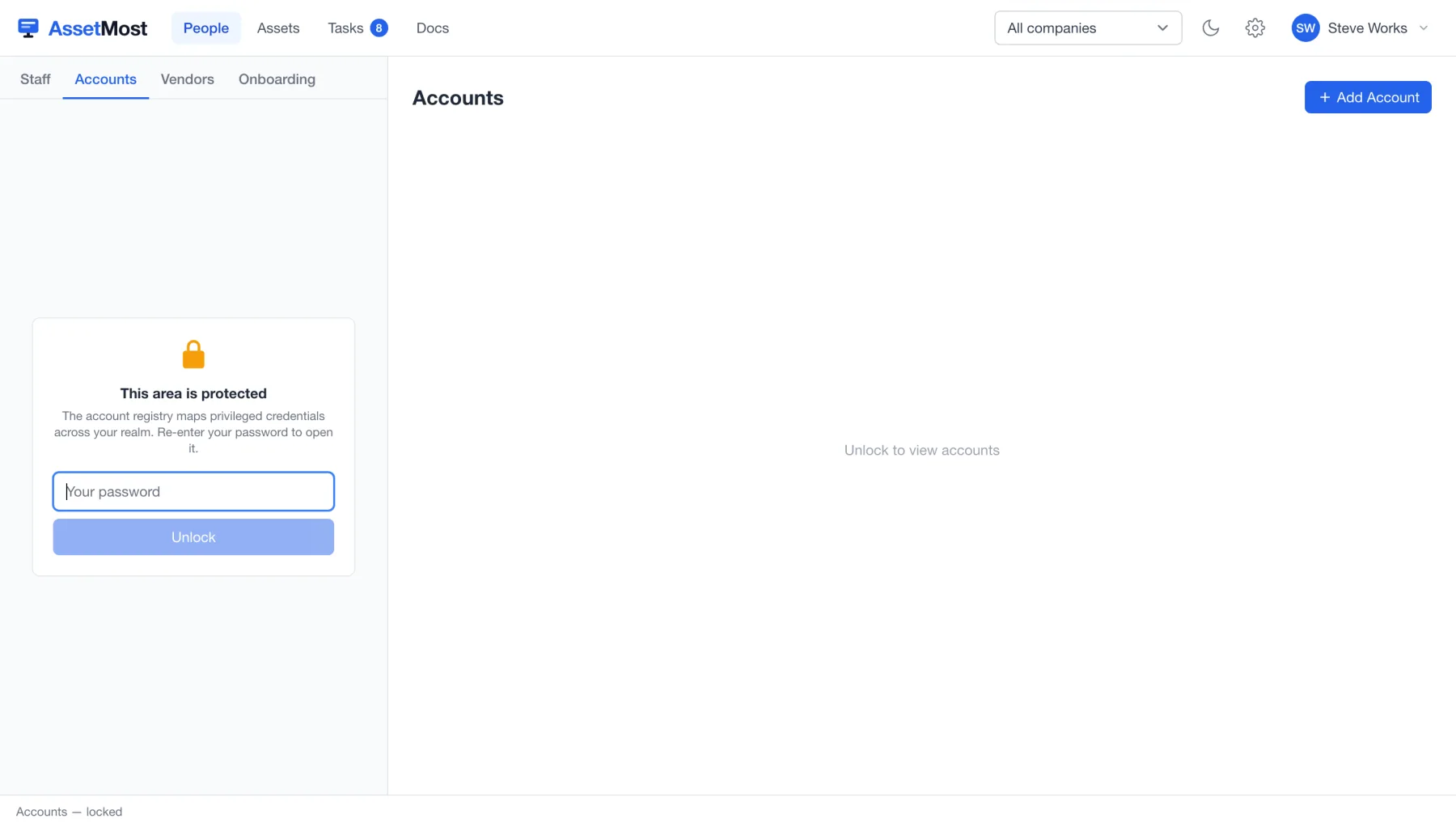
The account registry locked behind a re-authentication prompt
3 · Credentials

Shared accounts, guarded.

Pooled seats and service accounts, locked behind re-auth.
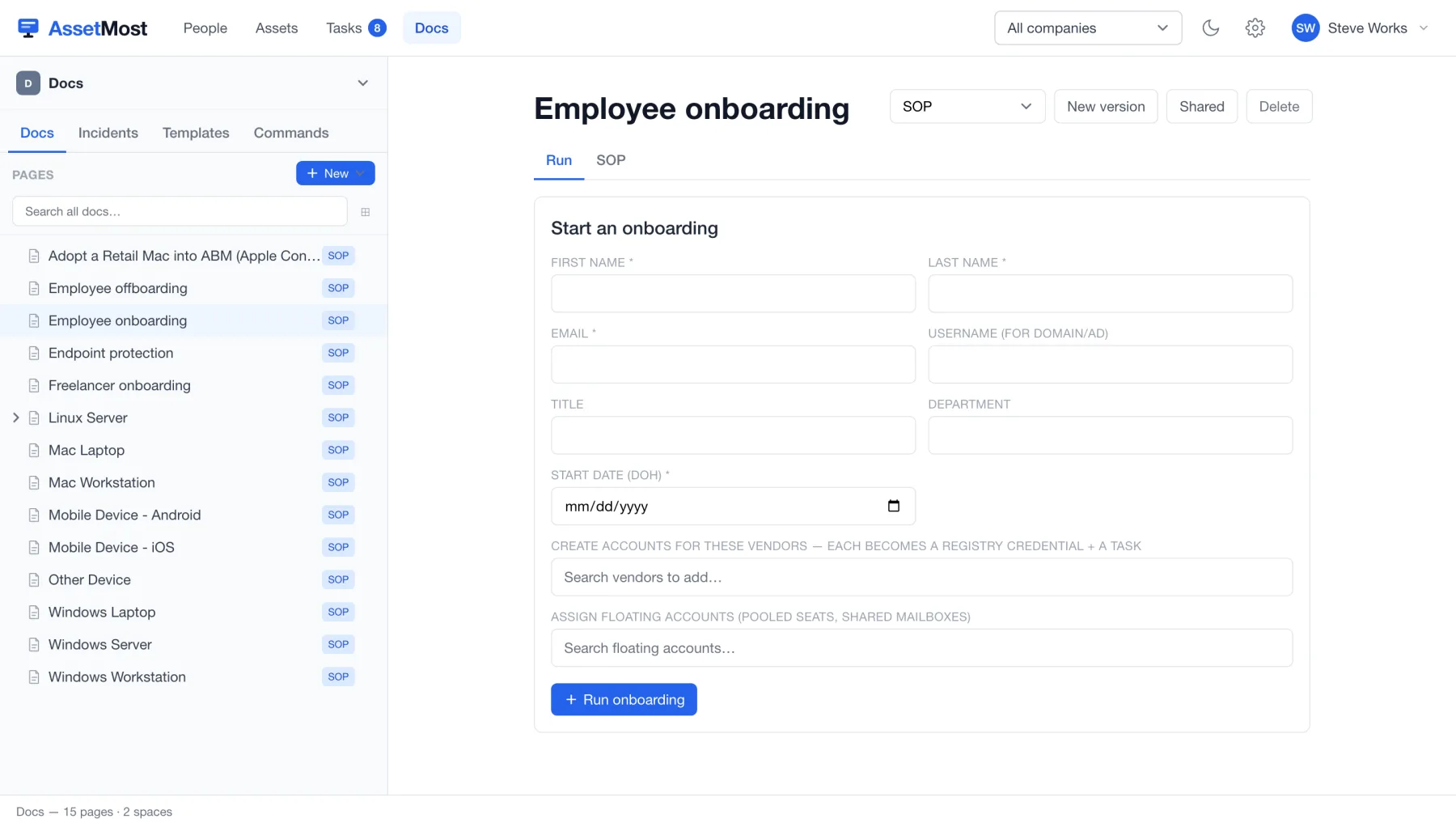
An onboarding SOP in Run mode: a form that creates the person, accounts, and tasks
4 · Onboarding

Onboarding you run, not read.

One workflow creates the person, the credentials, and the tasks.
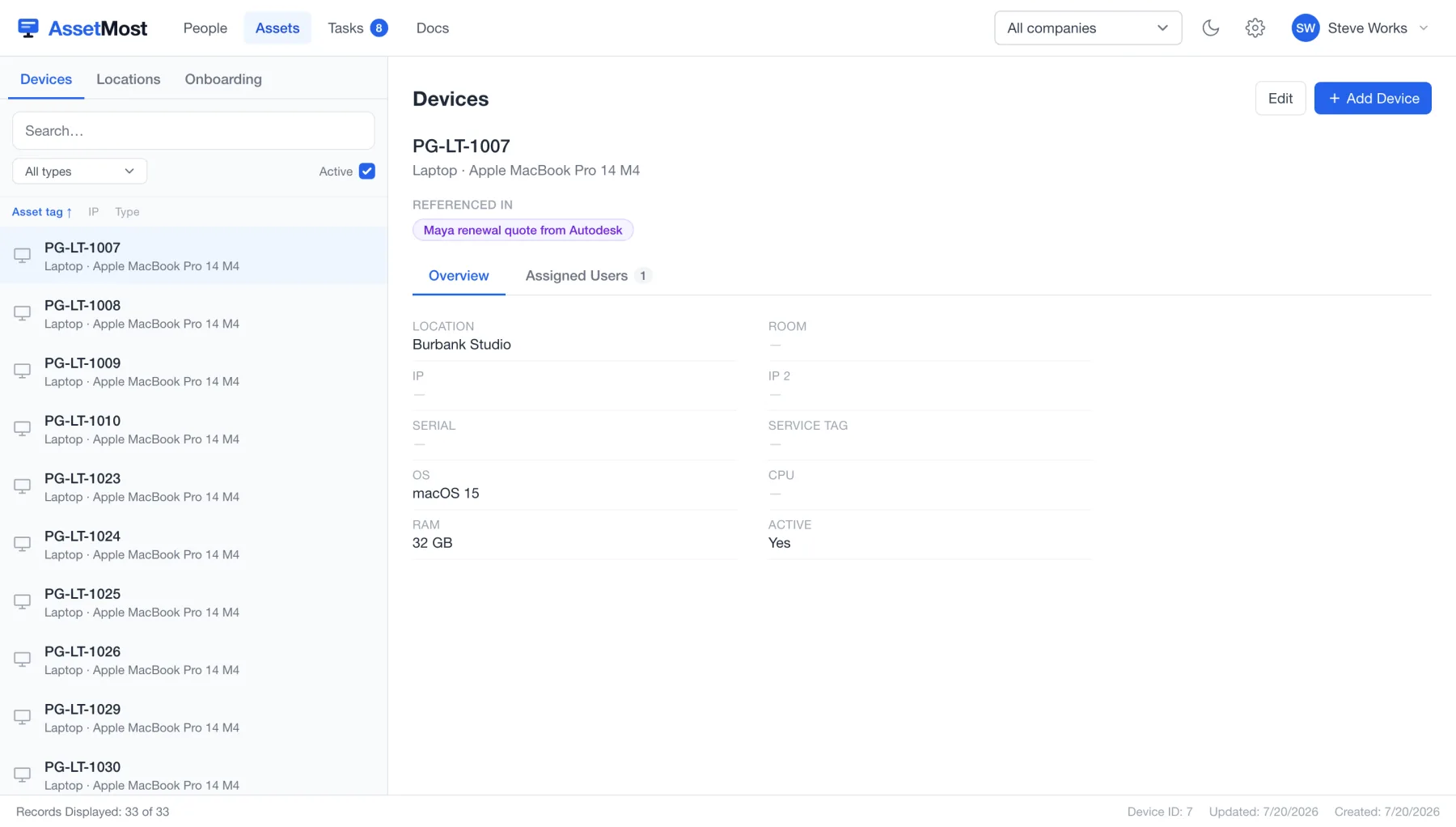
A device record: asset tag, model, specs, location, assigned users
5 · Assets

A tag that means something.

PG-LT-1007: company, type, number. Readable over the phone.
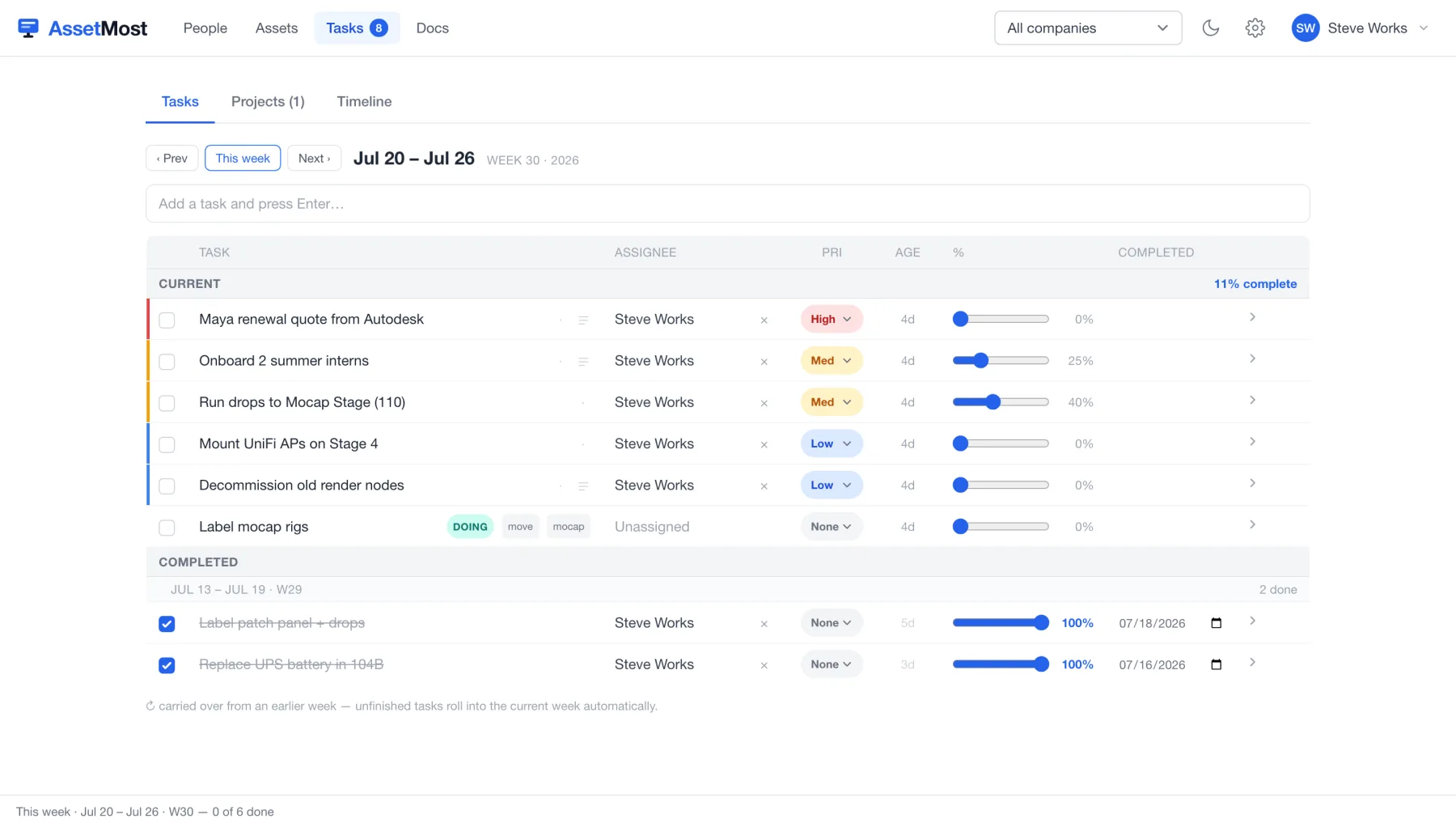
The weekly task sheet: priorities, progress, automatic carry-over
6 · Tasks

The week remembers itself.

Unfinished work rolls into the current week on its own.
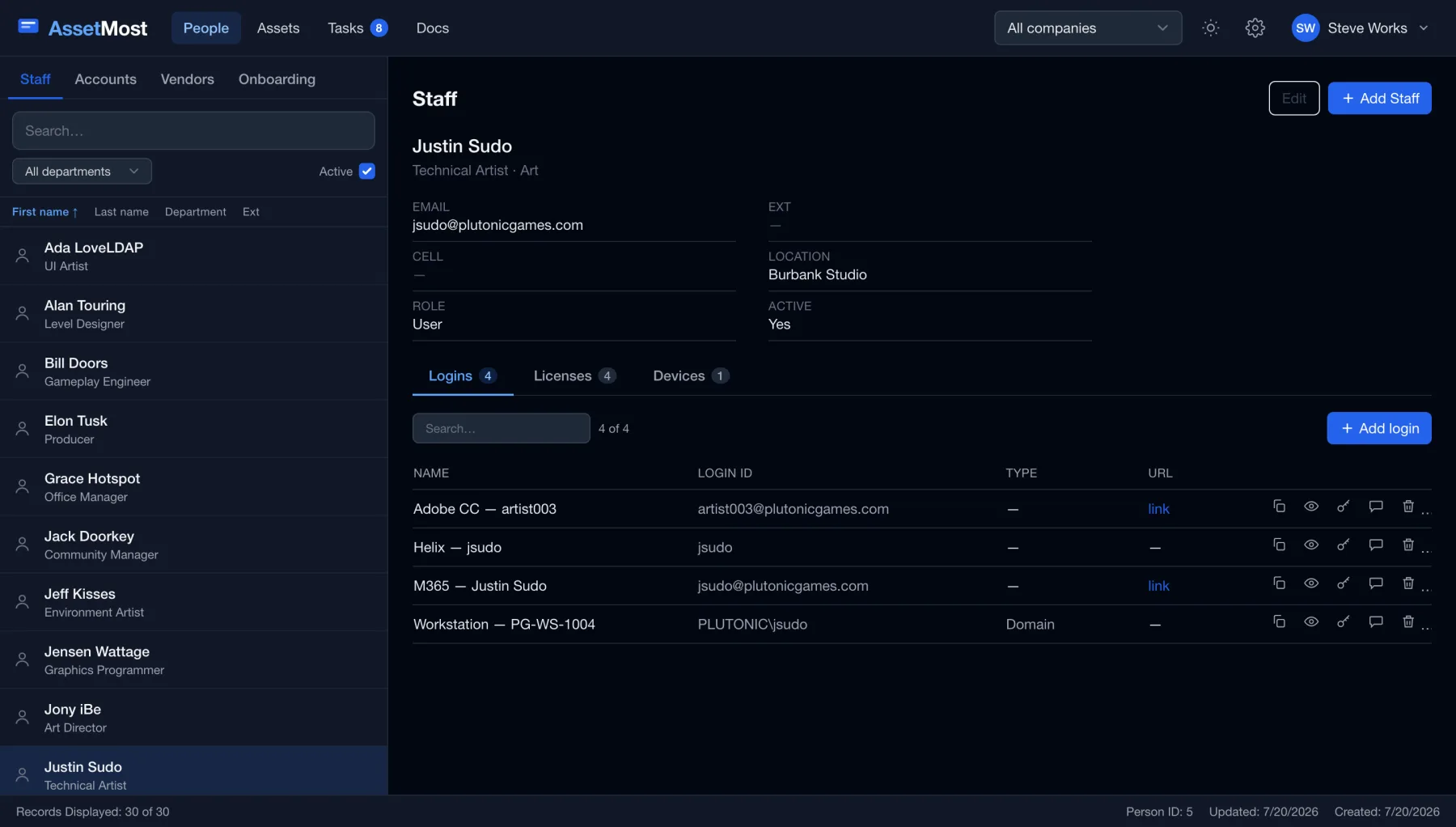
AssetMost in dark mode: the same staff profile at night
7 · Night shift

Even at 2 a.m.

Dark mode, one click in the header.
One workspace

Four cardinals, one desk.

IT Teamone workspace

People

devices · accounts · seats

Assets

tag · room · person

Projects

milestones · tasks · timeline

Docs

sops · runbooks · incidents
9:41 AM

You've heard of Agile. This is not it.

IT tools are often not designed for the business context they land in. Accounts get shared. info@ is pooled between 20 employees instead of being a distribution list. Password rotations are next to impossible for local accounts. Ambiguous asset tags delay support.

We went back to basics: no buzzwords, plain screens, rich information. With one small twist: actions, anywhere, when you need them.

AssetMost turns ambiguity into precision.

The whole idea

Unbloated features that connect… anywhere.

Best-in-class tools are great, but they're expensive and built for orgs with 200+ users. AssetMost brings you the best of the best in one convenient package.

Who has an Adobe seat? What's in room 104B? What's this credential for?

Wait — where are the tickets?

In your inbox, where they already live. AssetMost tickets run right in Outlook — triage, assign, and close them without a separate app, another login, or a new UI. Nothing new to learn.

Runs in Outlook
Onboarding intake

It starts with an email from HR.

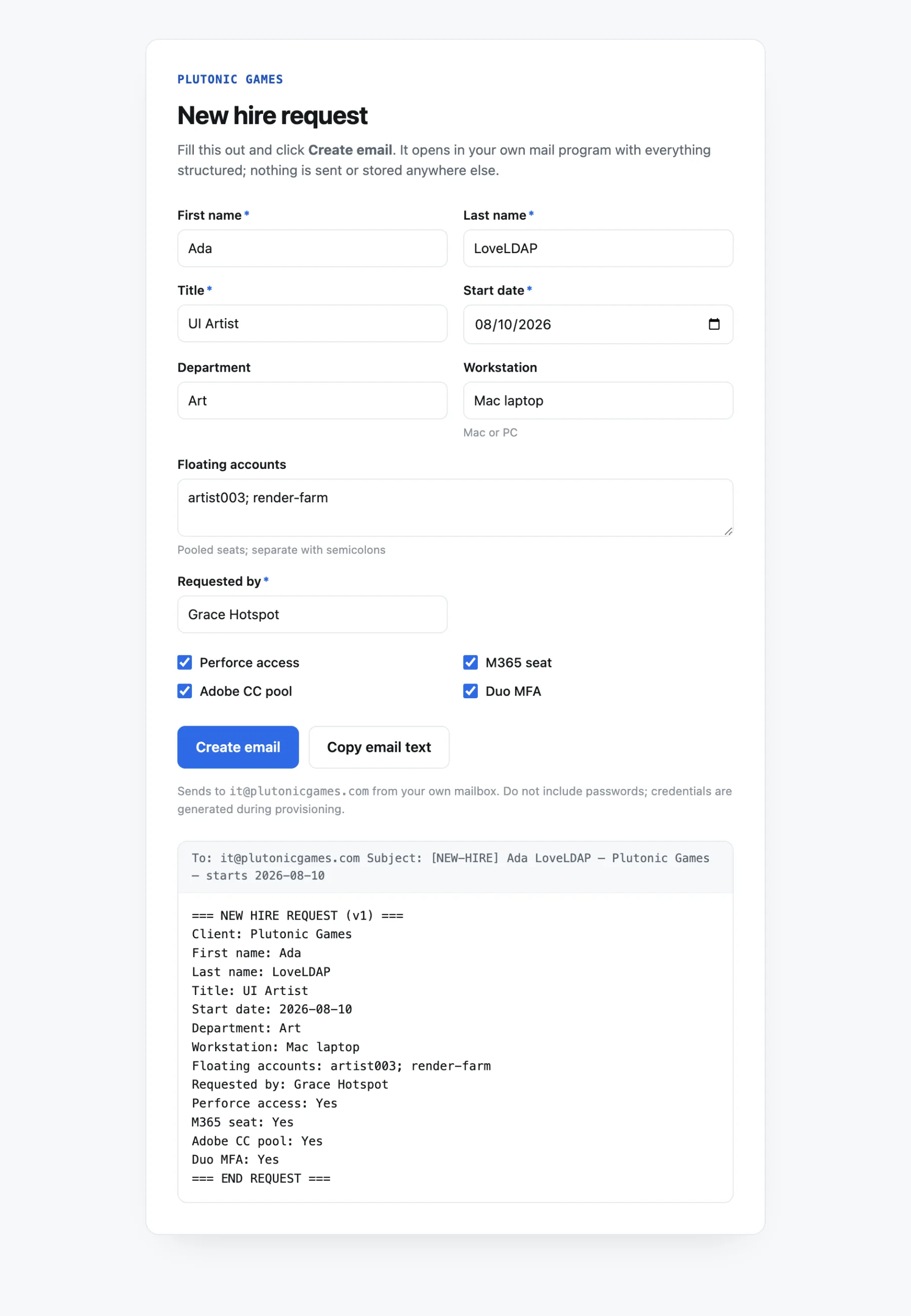
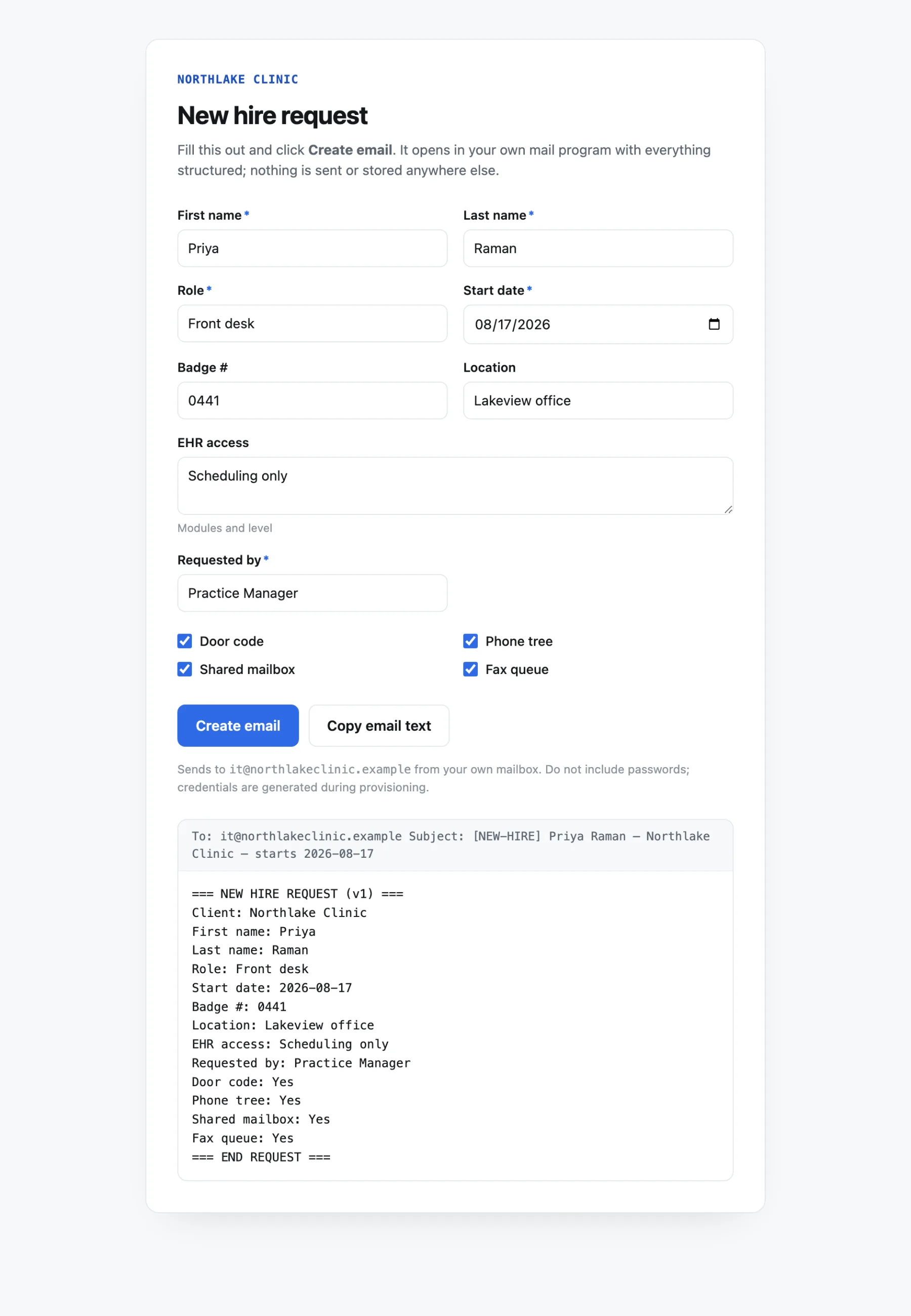
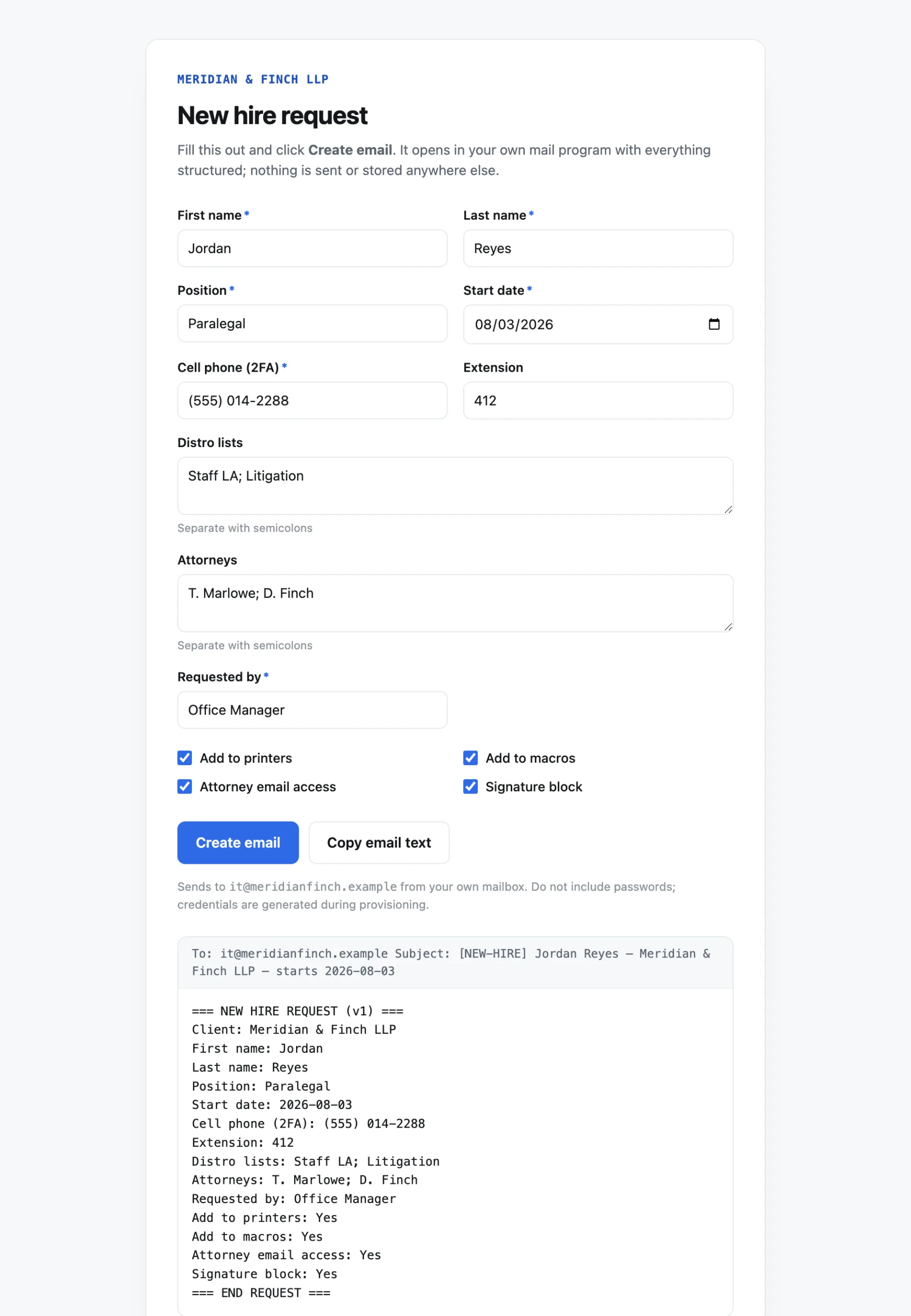
AssetMost generates a form per client: one HTML file they keep on their desktop. No portal, no server, no login. Fill it in, hit submit, and it writes the structured onboarding email.

The request lands in the inbox; AssetMost parses it and creates the task, and a human reviews it and runs it. That's how Justin Sudo got onboarded and Elon Tusk got offboarded in seconds. Need the cutoff at 2 o'clock? It's scheduled for 2 o'clock.

Chaos in, order out.

Meridian & Finch LLP onboarding form filled out, with the structured email preview
[NEW-HIRE] Jordan Reyes — Meridian & Finch LLP — starts 2026-08-03
Plutonic Games onboarding form with studio-specific fields like floating accounts and Perforce access
[NEW-HIRE] Ada LoveLDAP — Plutonic Games — starts 2026-08-10
Northlake Clinic onboarding form with badge, EHR access, and clinic-specific checkboxes
[NEW-HIRE] Priya Raman — Northlake Clinic — starts 2026-08-17
A note from the developer

Why I built AssetMost

People often ask me why I built AssetMost. The answer is simple: I see connections where others see separate systems.

Inventory, onboarding, licensing, security, documentation, user management: most people see independent tasks. I see one ecosystem. Disconnected, those systems create extra work, raise risk, and let things fall through the cracks.

I didn't set out to build another IT platform. I wanted the tool I wished I'd had throughout my career. The hardest parts of IT were never the extraordinary events; they were the routine ones. Onboarding and offboarding happen every day, yet they're among the highest-risk processes in any organization: a forgotten account, a missed license, an unsecured device that becomes an audit finding.

IT professionals manage assets, licensing, security, documentation, backups, vendors, and support, all at once and with limited resources. Yet the tools for that work are fragmented, overly complex, or priced beyond the organizations that could change the world for the better. AssetMost brings those pieces into one coherent system: one place for the work that lives across spreadsheets, sticky notes, and half a dozen applications.

The vision existed long before AI became mainstream. With its help, AssetMost became the culmination of twenty-plus years of spreadsheets, FileMaker databases, and PHP prototypes. AI is not a magic lamp. You still have to do the work.

IT professionals are already exceptional. AssetMost was built for their human side: the side that gets interrupted, inherits undocumented systems, juggles impossible workloads, and occasionally makes mistakes. Reduce the risk, connect the information, and exceptional people can spend their energy solving problems, helping people, and enjoying the work they chose.

That's why I built AssetMost.

— Enrique "Rick" Berrios

See it with your own data.

Self-hosted and open source. Clone it, seed the demo company, and click around the same screens you just saw.